
Table of Contents
- Why Modern Farmhouse Decor Still Works in 2026
- DIY Farmhouse Decor Projects That Cost Almost Nothing
- Best Places to Buy Farmhouse Decor Without Breaking the Bank
- Seasonal Farmhouse Home Accents for Every Budget
- Small-Space and Rental-Friendly Farmhouse Modifications
- How to Mix High and Low for a Curated Modern Farmhouse Look
- Common Mistakes That Make Budget Farmhouse Decor Look Cheap
- Frequently Asked Questions
Last Updated: September 11, 2026
Why Modern Farmhouse Decor Still Works in 2026
Modern farmhouse decor on a budget remains one of the most searched home styling topics heading into 2026, and the reason is simple: the look rewards restraint over spending. Customers hunt for cozy accents that feel collected rather than purchased every autumn. The aesthetic survives because it is built on neutral palettes, natural fibers, and a few well-placed focal points instead of expensive furniture.
That is also what makes it affordable.
The core of the style is a neutral palette warmed by distressed wood, galvanized metal, and soft textiles. None of those elements require a designer budget. A common mistake is treating farmhouse decor as a shopping list rather than a styling approach. The approach is what carries the room.
What follows is a practical breakdown of DIY projects, sourcing, seasonal accents, and the mistakes that make budget styling look cheap.
DIY Farmhouse Decor Projects That Cost Almost Nothing
DIY farmhouse decor projects deliver the biggest visual return for the smallest spend, because the style rewards imperfection. Distressed wood, hand-painted finishes, and slightly uneven textures read as authentic rather than sloppy.
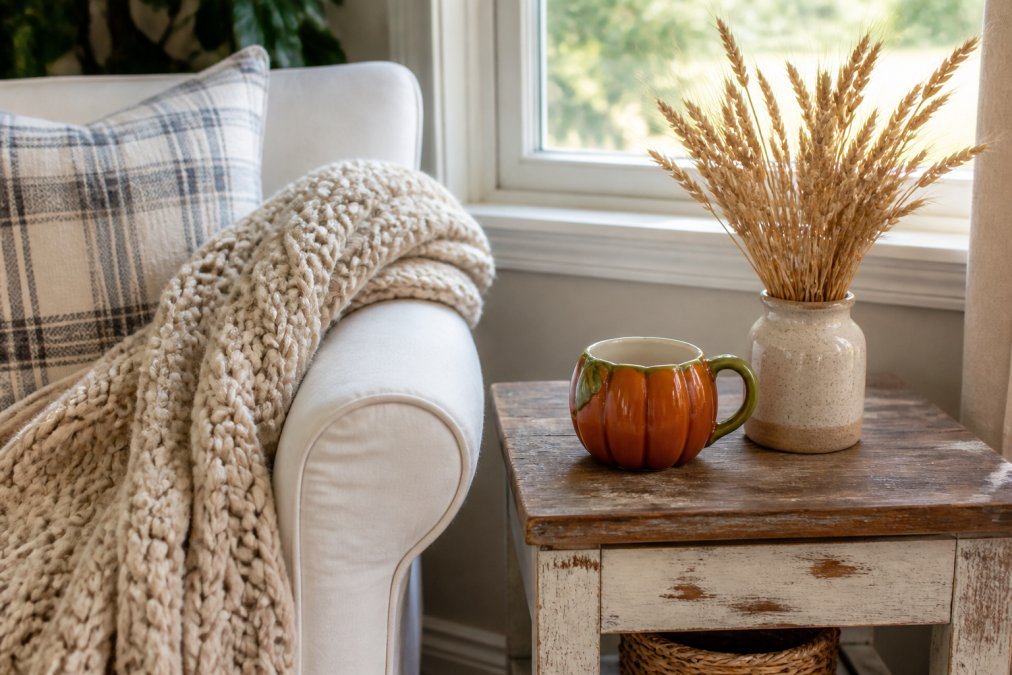
Start with what you already own. A plain wooden crate becomes open shelving storage once sanded and stained, glass jars with twine labels become pantry storage, and old picture frames painted soft white or warm gray become tray and gallery arrangements.
Shiplap Alternatives for Renters
Real shiplap is permanent, which is a problem if you rent. Peel-and-stick faux shiplap panels install with adhesive, remove without damaging drywall, and cost a fraction of a full install (homedepot.com). For a lighter touch, a single accent wall behind a bed or sofa delivers the same architectural detail.
Upcycled Thrift Store Makeovers
Thrifted finds are the backbone of budget farmhouse styling. Look for solid wood furniture with good bones, even if the finish is dated: chalk-style paint, light sanding on the edges, and new hardware transform a tired dresser into a repurposed centerpiece. Wicker baskets and galvanized metal containers add instant rustic accents for very little.
Best Places to Buy Farmhouse Decor Without Breaking the Bank
The best places to buy farmhouse decor are second-hand sources first, discount home retailers second, and small handmade shops last. The ranking is about cost per visual impact: solid wood and vintage pieces depreciate the moment they leave a retail floor, so buying used is the single biggest lever on a budget.
Second-Hand Sources: Where the Real Savings Live
Thrift stores, estate sales, church rummage sales, and online resale marketplaces consistently offer the lowest prices on solid wood and vintage accents. The trade-off is time: you cannot search for a specific item and expect to find it this weekend. Shop by category, not by item, walk in looking for "any solid wood side table under $30" rather than "a whitewashed farmhouse side table," and you will almost always leave with something usable.
Estate sales reward early arrivals on the first day for the best selection and late arrivals on the last day for the deepest discounts. Furniture marked at full price on day one often drops sharply on the final afternoon because the seller wants the house cleared, so the last two hours are usually the cheapest.
Online resale marketplaces are strongest for bulk textiles, curtains, throws, slipcovers, and for specific styles you cannot find locally. Search saved alerts for terms like "linen curtain panel," "jute rug," and "slipcover" rather than the word "farmhouse," which sellers rarely use.
Discount Retailers and Craft Stores: The Basics Layer
Discount home retailers cover the neutral basics well: cotton and linen-blend textiles, wicker and seagrass baskets, simple metal lighting, and plain ceramic vases. These are the items where the visual difference between cheap and expensive is smallest, so this is the right place to save. Craft and fabric stores handle the DIY side, chalk-style paint, wax finishes, twine, and unfinished wood blanks.
A useful rule of thumb: if an item is purely decorative and sits on a shelf, buy it cheap. If you touch it daily or sit on it, spend more.
Small Handmade Shops: The Character Layer
Small handmade sellers fill the gaps mass retail cannot, particularly seasonal pieces with real character. One or two handmade accents per room is usually enough to make a space read as collected rather than catalog-ordered.
| Source | Best For | Typical Savings vs. New Retail |
|---|---|---|
| Thrift and estate sales | Solid wood furniture, vintage accents | Highest |
| Online resale marketplaces | Specific styles, bulk textiles | High |
| Discount home retailers | Basics, lighting, storage | Moderate |
| Craft and fabric stores | DIY supplies, paint, twine | Moderate |
| Small handmade shops | Seasonal accents, gifts | Varies |
A high-low mix works best: one or two special pieces from a handmade seller, everything else sourced cheaply. That combination reads as curated rather than mass-produced.
The Sustainable Angle Most Budget Guides Skip
The cheapest farmhouse decor is usually also the most sustainable, because the two goals point the same direction: buy less, buy used, and keep what you already own in circulation. Reclaimed wood from pallets, old fence boards, and salvaged barn siding costs little or nothing and carries the weathered texture new lumber has to be artificially distressed to imitate. Upcycling a piece you already own, repainting a dresser, re-covering a chair cushion, restaining a table, avoids both the purchase price and the shipping footprint of a replacement.
Natural materials like cotton, wool, jute, and linen biodegrade and age gracefully, while synthetic lookalikes pill, shine, and yellow. Prioritizing natural fibers over polyester blends keeps budget pieces looking higher-end for longer and out of the waste stream when you move on.
Seasonal Farmhouse Home Accents for Every Budget
Seasonal farmhouse home accents are the fastest way to refresh a room without repainting or replacing furniture. Swapping textiles and small decor items each season changes the mood of a space for very little money, and if you store and reuse the same pieces year after year, the cost per season drops every time.
The Swap-Not-Shop Method
The core mechanic is substitution, not accumulation. Instead of buying new decor each season, rotate a small set of neutral base pieces and change only the accents on top. A cream throw, a woven basket, and a wooden tray stay out year-round; what changes is the textile color, the greenery, and one or two small objects.
A practical seasonal rotation looks like this:
- Autumn: warm tones, dried wheat or eucalyptus stems, small pumpkins, chunky knit throws, amber glass
- Winter: deeper neutrals, evergreen sprigs, wool blankets, matte white ceramics, brass accents
- Spring: soft whites and pale greens, fresh or faux tulips, cotton throws, clear glass
- Summer: natural jute, seagrass, linen, dried grasses, stoneware in warm clay tones
Because the base stays the same, each season only requires two or three new or reused accent items. That is the difference between a $15 seasonal refresh and a $150 one.
Small Accents Do More Than Large Ones
A ceramic mug with a seasonal design on an open shelf does more for a room than a large decorative piece, because it signals the space is lived in. The same logic applies to a stack of books with a small object on top, a bowl of dried oranges, or a single stem in a narrow vase. These vignettes cost almost nothing and photograph well, which is why they dominate farmhouse styling content.
This is where Goosie Plum Crochet fits naturally. Our autumn-inspired ceramic mugs, postcard bundles, and vinyl stickers are designed as small, affordable accents that slot into existing farmhouse styling. A pumpkin-design mug on a wooden tray or beside a stack of books is exactly the kind of vignette that makes a neutral room feel festive.
Making Seasonal Decor Last More Than One Year
Budget seasonal decor only stays budget if it survives storage. The two failure points are moisture and crushing.
- Store textiles clean and fully dry. Damp wool or cotton grows mildew in a sealed bin within weeks (extension.psu.edu).
- Use rigid bins for ceramics and glass rather than soft bags, which let items shift and chip.
- Keep natural materials like dried stems, wheat, and eucalyptus in a dry closet, not a garage or basement where humidity swings.
- Label bins by season so you are not digging through winter items in October.
People often replace seasonal decor every year not because it wore out, but because it was stored badly. Treating a $10 basket or a $12 mug as a reusable piece rather than a disposable one is the easiest way to cut seasonal spending over time.
Where Seasonal and Sustainable Overlap
Dried botanicals, cotton and wool textiles, and ceramic or glass accents age better than plastic and foam lookalikes, and they can be composted or recycled when they wear out (the EPA). Reusing the same neutral base pieces across seasons means fewer purchases overall, the most direct sustainability win available to a budget decorator. The goal is not to buy eco-friendly versions of everything, but to buy fewer things and keep them longer.
Small-Space and Rental-Friendly Farmhouse Modifications
Rental-friendly farmhouse modifications focus on changes you can reverse. Removable wallpaper, adhesive hooks, freestanding shelving, and slipcovered furniture deliver the farmhouse aesthetic without drilling, painting, or permanent installation.
Small spaces benefit most from vertical styling. Open shelving above a desk or kitchen counter adds storage and visual interest at once. A single focal point, such as one styled shelf or one accent wall, prevents a small room from feeling cluttered.
- Use peel-and-stick panels for architectural details
- Choose slipcovered furniture over upholstered pieces
- Add freestanding open shelving instead of built-ins
- Layer textiles to soften plain walls and floors
- Keep the neutral palette consistent to make the space feel larger
Space planning matters more in small rooms than in large ones. Group decor into two or three styling vignettes rather than scattering items across every surface.
How to Mix High and Low for a Curated Modern Farmhouse Look
Mixing high and low is what separates a curated modern farmhouse room from a showroom catalog. The technique is straightforward: spend on pieces you touch daily and save on everything decorative.
Invest in one or two anchor items, such as a quality slipcovered sofa or a solid wood dining table. Save on textiles, wall decor, and seasonal accents, where the visual difference between cheap and expensive is smallest. A single handmade mug or small bundle of postcards can carry the same weight as a pricier object when it sits in the right spot.
Color coordination keeps the mix from looking chaotic. Stick to a neutral palette of whites, warm grays, and soft browns, then introduce one seasonal accent color at a time. Textural layering, combining natural fibers like cotton, wool, and jute, adds depth without adding cost.
Common Mistakes That Make Budget Farmhouse Decor Look Cheap
The biggest mistake is buying too much at once. Budget farmhouse decor fails when a room fills with small, inexpensive items that have no relationship to each other, reading as cluttered rather than cozy.
Other frequent errors include:
- Mixing too many wood tones in a single room
- Using shiny, synthetic materials next to natural fibers
- Skipping texture and relying only on color
- Hanging wall decor too high or too sparsely
- Ignoring scale, so tiny accents disappear in large rooms
- Buying trend pieces that clash with the neutral base
A common mistake is treating "budget" as permission to buy more. Restraint is what makes the style work. Fewer, better-chosen pieces always outperform a room full of cheap ones.
Maintenance matters too. Natural fibers need occasional cleaning, and painted furniture chips if it is not sealed. Budget decor lasts when treated like real furniture rather than disposable decoration. For an eco-friendly approach, prioritize second-hand and natural materials over new synthetic items, keeping older pieces in circulation and reducing waste.
Styling a farmhouse home on a budget comes down to restraint, texture, and a few well-chosen accents rather than a large spend. Goosie Plum Crochet makes that easier with autumn-inspired ceramic mugs in 11oz and 15oz sizes, postcard bundles that include envelopes, and vinyl stickers designed to slot into existing decor. Each piece is designed to add cozy, seasonal character. Add a Goosie Plum Crochet accent to your space and let one small detail carry the whole vignette.
Frequently Asked Questions
What are some cheap and modern farmhouse decor options?
Thrifted furniture, DIY shiplap alternatives like peel-and-stick wallpaper, and budget-friendly finds from dollar stores or online marketplaces can create the modern farmhouse look for less. Focus on neutral palettes, distressed wood accents, and textural layering with natural fibers like cotton and jute. Repurposing vintage items, such as old crates or mason jars, adds vintage charm without a big spend. Seasonal accents, like handmade mugs or postcard bundles, bring cozy atmosphere affordably.
How can I make my home look like a modern farmhouse on a budget?
Start with a neutral palette of whites, creams, and soft grays, then layer in rustic accents like galvanized metal, wicker baskets, and distressed wood. Use DIY projects such as upcycled furniture or handmade wall decor to cut costs. Shop thrift stores, estate sales, and online marketplaces for vintage finds. Add cozy atmosphere with slipcovered furniture and natural fiber textiles. Small changes, like swapping hardware or adding open shelving, deliver a big home refresh without major renovation.
What are common mistakes in farmhouse decor?
Overloading a space with too many rustic accents can make a room feel cluttered rather than curated. Ignoring scale and proportion, such as using tiny decor on large walls, creates visual imbalance. Skipping textural layering leaves a room flat. Another mistake is mixing too many wood tones without a unifying neutral palette. Rushing to buy everything at once often leads to a mismatched look. Instead, build gradually, mixing high and low pieces for a collected, authentic farmhouse aesthetic.
Where can I find affordable modern farmhouse accents?
Thrift stores, flea markets, and online resale platforms are top sources for budget-friendly farmhouse decor. Dollar stores often carry neutral vases, baskets, and faux greenery. Craft stores offer supplies for DIY projects like painted signs or upcycled furniture. Seasonal farmhouse home accents, such as handmade mugs or postcard bundles from small shops, add charm without a high price tag. Always check clearance sections and end-of-season sales for the best deals on timeless pieces.